Your sunshine for your home, not for the grid
Barnex sends your solar surplus into water heaters and your EV. And keeps the main breaker from tripping.
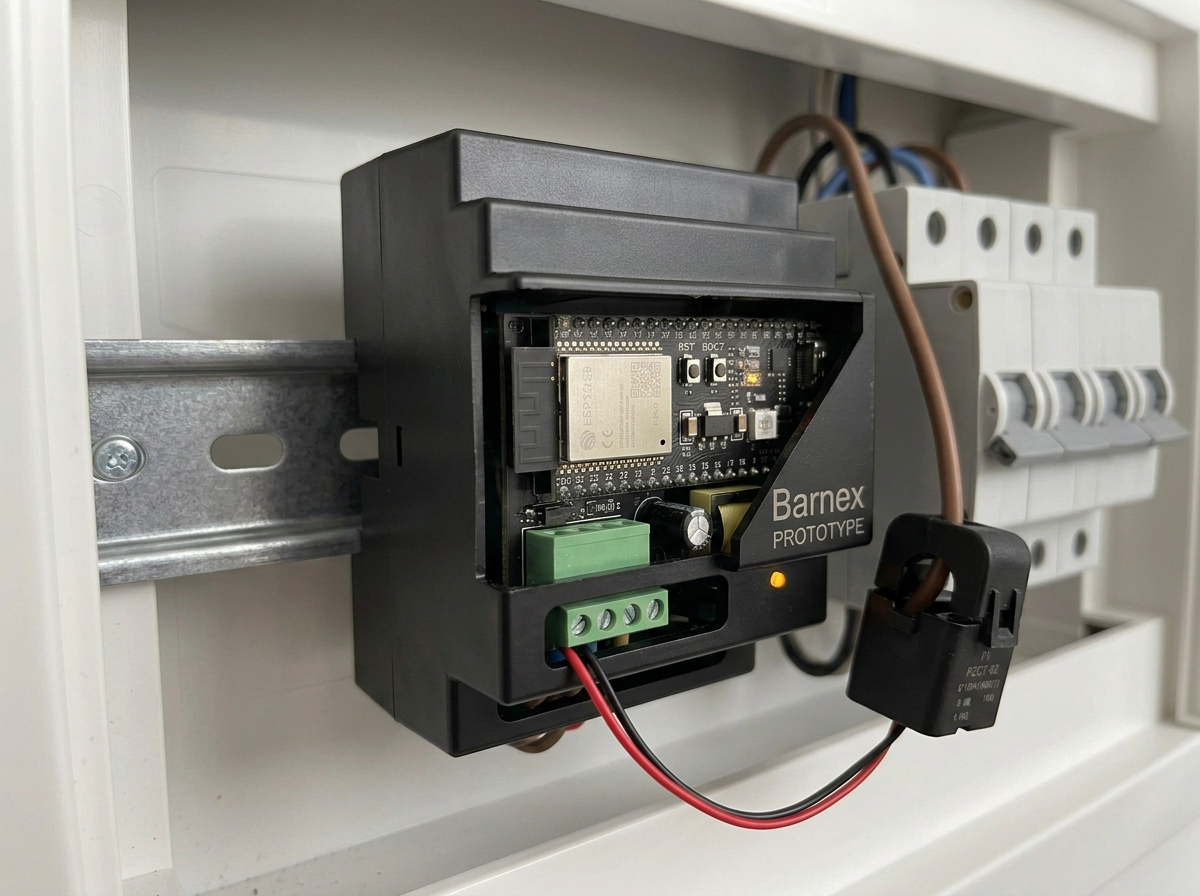
Barnex DIN prototype in a distribution board.
Your solar system exports what you already paid for
During the day the panels produce more than the house consumes. The surplus goes to the grid — for pennies or for nothing at all. And in the evening you heat water and charge the car at the full tariff.
- Surplus is exported for free or nearly free
- Heater and charger run during the most expensive hours
- Separate devices for water and car do not see each other
- Running the heater and charger together trips the main breaker
How it works
Four steps and grid export drops to zero
Connection — without a single wire
If CT clamps are already connected to your inverter, installation takes a minute. Plug Lite into a USB charger, or mount DIN and Power in the panel — that's it. No other connections. Barnex connects to Wi-Fi by itself, finds the inverter and takes grid consumption data from there.
Own CT clamps are included with the DIN and Power versions — for inverters that cannot measure grid consumption on their own. The clamps simply clip onto the main cable, with no wiring cuts.
Surplus distribution
Barnex calculates the exact surplus and splits it between water heaters and EV charging by your priorities.
Zero export
Grid export drops to zero. The energy stays in your home.
Breaker protection
Barnex watches total household load and, as it nears the limit, first cuts water heaters, then throttles charging current, so the main breaker never trips.
Key advantages
15-minute installation
No signal cable to run across the whole house to the inverter.
Unlimited water heaters
Each with its own priority. Dump the surplus sequentially in order, or simultaneously to all devices.
EV charging control
EVSE, Electros and any charger with OCPP 1.6/2.0.1. Car and heater coordinate instead of competing.
Main breaker protection
Barnex knows the total load of the house and, when the limit gets close, first sheds the heaters, then reduces charging current.
Flexible rules
By schedule, by battery state of charge (SOC), by a 3-day weather forecast, by night tariff.
Open inverter support
New models are added with a plain .json file containing the Modbus register map. No waiting for vendor firmware.
Three models
The logic is identical in all three models — the same firmware, the same capabilities. The difference is where the measurement comes from and how much hardware is already assembled for you.
We don't spend your money on a designer enclosure. Barnex lives in a cabinet and looks like an ordinary automation module. All the money went into what's inside, and into the firmware.
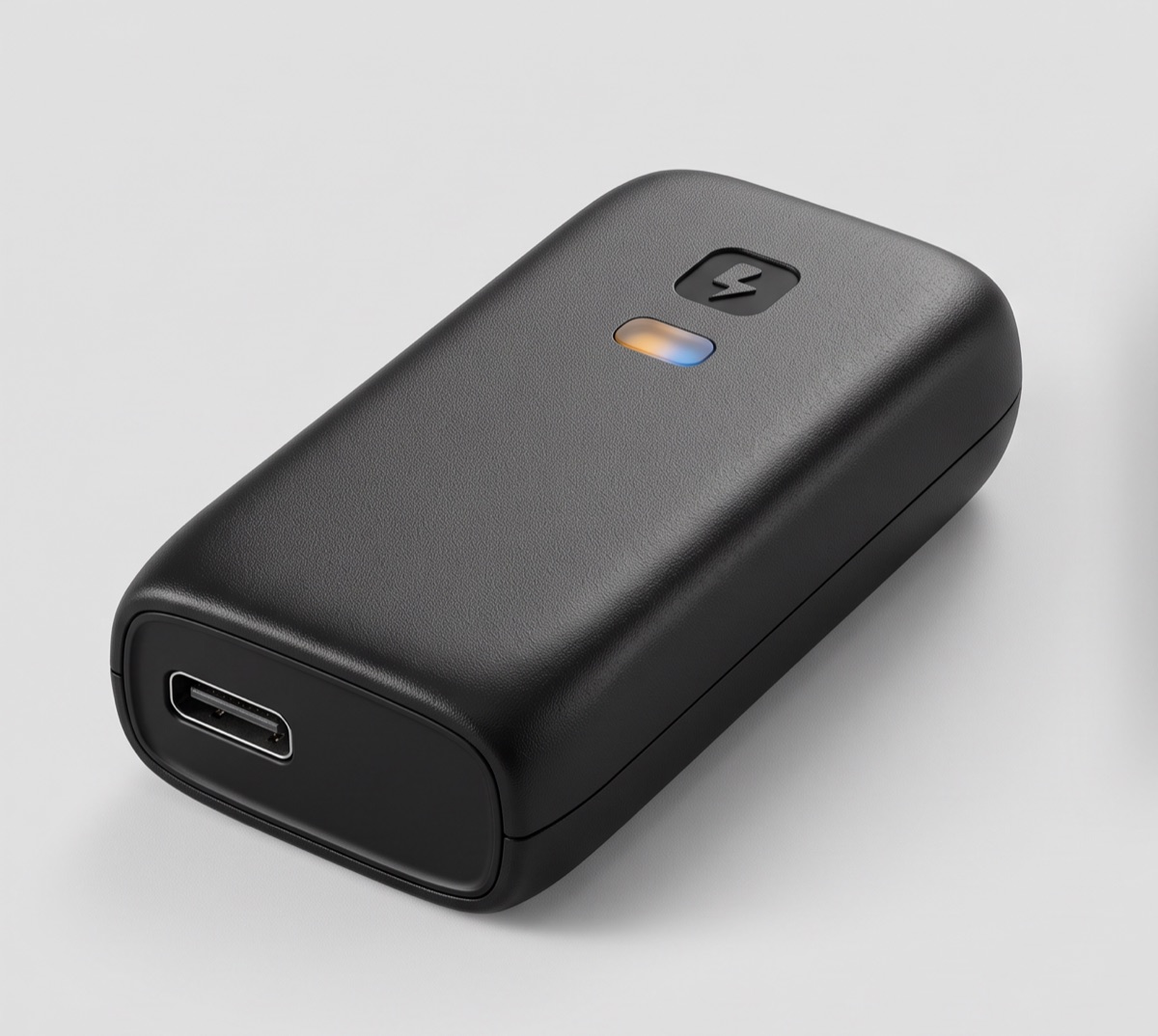
Rendering of the production enclosure. Black, powered by any 5 V USB-C adapter.
Barnex Lite
A coordinator without the power stage
2999 UAH
Who it's for
Your inverter is reachable over the network via Modbus TCP (Wi-Fi or LAN) and already has CT clamps connected. You are ready to build or buy heater nodes separately. Or for now you only need smart EV charging.
What it does
- Main breaker protection — dynamically lowers charging current when the house draws too much
- Charging control: OCPP 1.6/2.0.1, EVSE, Electros
- Heater control through Wi-Fi heater nodes — unlimited number, with priorities
- Schedules, night tariff, rules by battery SOC
- Telegram notifications, local operation without internet
What's inside
- ESP32-S3, Wi-Fi
- Compact USB-C enclosure, powered by any 5 V adapter
- No electrician needed: plug it into a USB charger — that's it
What it lacks
- Own measurement. Lite takes consumption data from the inverter over Modbus, so it works only with inverters that already have CT clamps connected. If your inverter does not measure grid consumption, you need the DIN or Power version
- RS485 — Lite talks to the inverter only over the network (Modbus TCP). For Modbus RTU over a cable you need the DIN or Power version
- A power stage — the heater connects through a separate Wi-Fi node. The node's schematics and firmware are open, you can build it yourself
Plastic DIN-rail enclosure, 3 modules. White or black.
Barnex DIN
Own measurement, no dependency on the inverter
4999 UAH
Who it's for
Your inverter has no Modbus or connected CT clamps — DIN measures consumption on its own, faster and independent of the inverter. The heater still connects through a separate Wi-Fi node, same as Lite.
What it does — everything Lite does, plus
- Sees a load change in less than a second. Own CT clamps and measurement path on board — no intermediaries
- Works with any inverter, even without Modbus
What's inside — already assembled and wired
- ESP32-S3, Wi-Fi, RS485
- CS5460A measurement path
- CT clamps included
- Isolated power supply
- Plastic DIN-rail enclosure, 3 modules
What it lacks
- A power stage — the heater connects through a separate Wi-Fi node, same as Lite. The node's schematics and firmware are open, you can build it yourself. A ready power output (SSR + relay, burst-fire) exists only on the Power version
All you have to do is mount the module in the board and connect the CT clamps. Everything else is already soldered and tested.
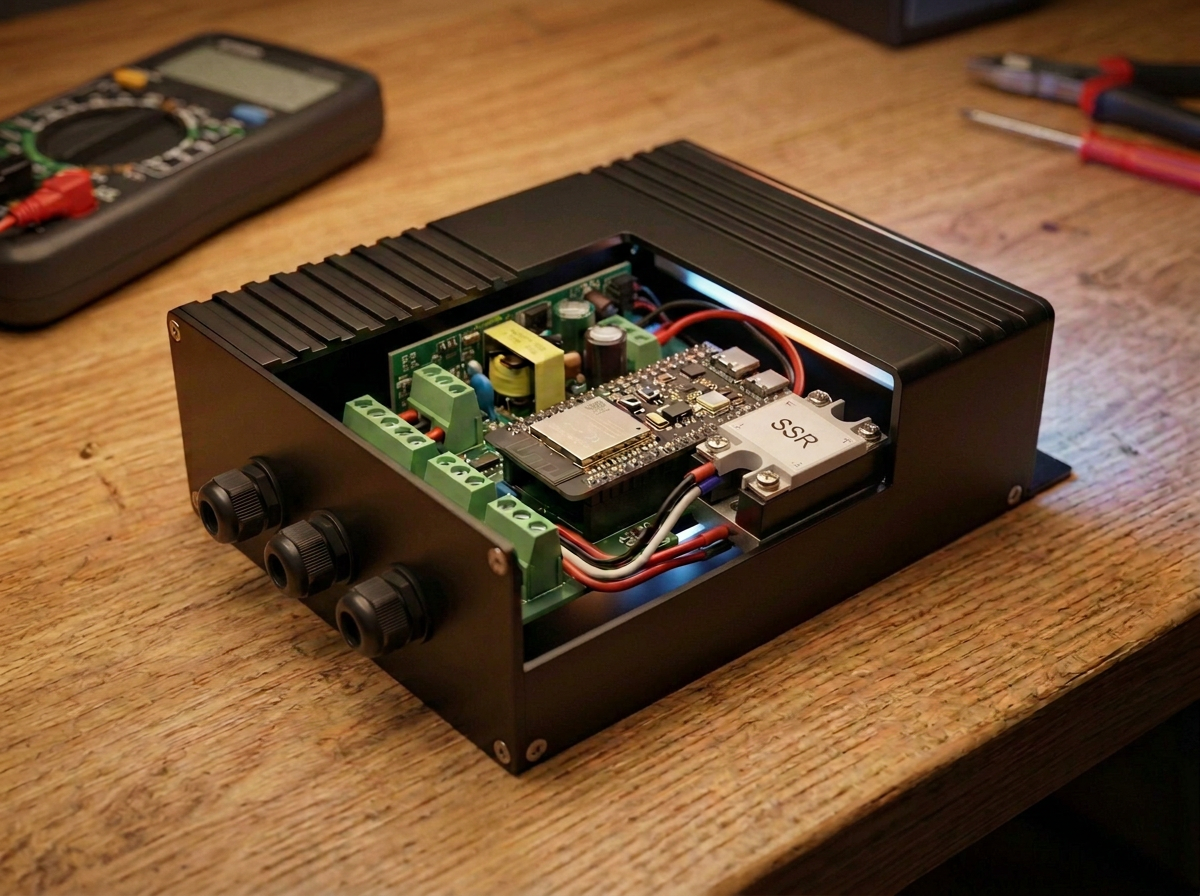
Aluminium enclosure, black, 150 × 180 × 45 mm, with cooling fins. Wall mounting.
Barnex Power
With a ready power output for the heater, in aluminium
9999 UAH
Who it's for
You need a ready power output for the heater right out of the box, without building a separate Wi-Fi node. Or the device will be in plain sight, there is no DIN space in the board, or you want to see your home's energy at a glance.
What it does — everything DIN does, plus
- A ready power output for the heater right out of the box
- Smooth burst-fire power control with zero crossing
What's inside — already assembled and wired
- ESP32-S3, Wi-Fi, RS485
- CS5460A measurement path
- CT clamps included
- Solid state relay (SSR) with a heatsink
- A power relay in parallel with the SSR — extends SSR life
- Isolated power supply
How the enclosure differs
- Aluminium enclosure, black, 150 × 180 × 45 mm, with cooling fins
- The SSR is pressed to the enclosure through thermal paste — the body works as a heatsink and holds higher power for longer
- An LED strip along the top edge with animations: shows house consumption, heater dumping and EV charging in real time
- Wall mounting
All you have to do is mount the module in the board or on the wall and connect input and output. Everything else is already soldered and tested.
One firmware for all models. Start with Lite — you can add a heater node later without reconfiguring anything.
Why measurement speed matters
When a kettle switches on or a pump starts, house consumption jumps instantly. The faster the coordinator sees it, the less energy is pulled from the grid, and the closer to the breaker limit you can keep EV charging.
Barnex DIN and Power — under 1 second
Own CT clamps → measurement path → decision. A direct route, no network.
Barnex Lite — up to 5 seconds
Inverter CT clamps → processing in the inverter → Modbus over Wi-Fi → Barnex → decision. Depends on Wi-Fi quality and the inverter polling rate.
For most homes 5 seconds is quite enough — the thermal curve of a main breaker is measured in minutes, not seconds. But if you have powerful loads with sharp start-ups, or you want to keep charging as close to the breaker limit as possible, own measurement gives a bigger safety margin.
These are load-change detection times measured on our prototype. The total time until charging current changes is longer — it depends on the charging station and the car. The real Lite delay depends on the inverter model and Wi-Fi quality.
What's inside
Scroll the table horizontally
| Capability | Lite | DIN | Power |
|---|---|---|---|
| Modbus to inverter | TCP (Wi-Fi/LAN) | ||
| EV charging control (OCPP) | |||
| Main breaker protection | |||
| Water heater control | Via Wi-Fi nodes | Via Wi-Fi nodes | Wi-Fi nodes + built-in output |
| Unlimited water heaters | |||
| Priorities between loads | |||
| Schedules, SOC, night tariff | |||
| Consumption data source | Inverter CT clamps (Modbus) | Own CT clamps | Own CT clamps |
| Load change detection time | up to 5 s | under 1 s | under 1 s |
| CT clamps included | |||
| Inverter requirements | Modbus TCP + connected CT clamps | Any | Any |
| Ready power output (SSR + relay) | |||
| LED energy flow indication | Basic | Basic | Animated strip |
| Enclosure | Compact, USB-C | DIN, 3 modules | Aluminium 150×180×45 |
| Local operation without internet |
Use cases
A single water heater
All surplus goes into heating water. Smooth power dosing instead of full-power switching.
Several heaters with priorities
First the main tank, then the second and third — or all at once, proportionally to the surplus.
Water heater + EV
Car and water are coordinated: while the car charges, the heater takes the remainder, and vice versa.
Technical specifications
- Processor
- ESP32-S3
- Measurement
- CS5460A + CT clamps (DIN, Power)
- Power output
- SSR + 30 A relay (Power only)
- Interfaces
- Modbus TCP/RTU, MQTT, Wi-Fi
- Inverters
- Deye, Growatt, SolaX, Solis, Fox ESS + extendable via .json maps
- Chargers
- EVSE, Electros, OCPP 1.6/2.0.1
- Notifications
- Telegram
- Updates
- OTA with cryptographic signature
- Power supply
- 230 V (DIN, Power), USB-C 5 V (Lite)
- Mounting
- DIN rail or wall (DIN, Power), anywhere near a socket (Lite)
Compared to competitors
Scroll the table horizontally
| Capability | Barnex | Solar Vampire SV701/705 | myenergi Eddi | myenergi Zappi | Fronius Ohmpilot |
|---|---|---|---|---|---|
| Connection | CT clamps or Modbus, wireless | RS-232/RS-485 cable to inverter | CT clamps | CT clamps | Cable to Fronius inverter |
| Number of water heaters | Unlimited | 1 | 2 | 0 | 1 |
| Priorities between heaters | |||||
| Simultaneous dump to all devices | |||||
| EV charging control | |||||
| OCPP support | |||||
| Car-or-heater priority | |||||
| Main breaker protection | |||||
| Smooth power modulation | Via external 0-10V/4-20mA regulator | ||||
| Rules by battery SOC | |||||
| Adding new inverters | Modbus .json map, by yourself | Vendor firmware only | Vendor firmware only | Vendor firmware only | Vendor firmware only |
| Works without internet | |||||
| Indicative price | from 2999 UAH (Lite) / 9999 UAH (Power) | 1100 UAH per module+ an LA-rated SSR, heatsink, 12 V PSU, RS232→RS485 converter, signal cable — a working set ≈ 1800–2200 UAH | ~£482 incl. VAT | from £599 (GLO) / £779 (2.1) | ~€940+ a mandatory Fronius Smart Meter, works only with Fronius inverters |
Competitor prices were collected from public sources as of 09.2026 and are indicative.
Barnex is not the cheapest device on the list. Solar Vampire costs less and does its job well: controlling one water heater through a separate solid state relay. Barnex makes sense when there are several heaters, when there is an EV, or when you don't want to run a signal cable across the whole house. The fair comparison is not with the price of a module, but with the price of Eddi + Zappi together.
I have a Deye inverter and their charger. Why would I need Barnex?
Deye SUN-EVSE is a decent charger. But it solves only one task out of four, and it solves it inside its own closed ecosystem.
It's only a charger
It knows nothing about your water heater. There are no priorities between car and water, and no way to split the surplus between them.
You need extra accessories
For the charger to see the surplus you also need a Deye Smart CT (SUN-SMART-CT01) and a LoRa transmitter (SUN-SMART-TX01).
No main breaker protection
The charger limits only its own current and does not see the rest of the house. When the heater, the cooker and the charger run at once, nobody watches the total incoming current.
Slower reaction to surplus changes
Control goes through a LoRa channel from the inverter with a limited polling rate. In our measurements, when a cloud covers the panels, the charger keeps pulling from the grid for a while.
Tied to the cloud and the brand
Modes are configured through Deye Cloud. No internet — no control. Change the inverter and the charger loses its smart features.
Barnex does not replace the Deye charger — it makes it smart and adds what it lacks: water heaters, priorities and main breaker protection.
Right now this is a working prototype
The device already runs every day in a real home system. We are preparing it for series production. Sales start at the end of February. You are seeing the project at a stage where you can still shape what it becomes.
What to add to Barnex?
The device is still in development, and now is the best moment to shape what it becomes. Much of what Barnex already does appeared at the request of the first users.
Not on Telegram? Write to hello@barnex.io hello@barnex.io
Pre-order
Choose a model and reserve your place in the first batch
- Deposit
- 499 UAH
- Full price
- 4999 UAH
- Balance
- 4500 UAH
The production order depends on which model gets more orders. We will tell exact dates to everyone who reserved.
What the reservation gives you
- A place in the first batch
- A fixed price regardless of exchange rates
- Direct contact with the developer and influence on features
- A refund of the deposit at any time before shipping, no questions asked
Frequently asked questions
Deye, Growatt, SolaX, Solis and Fox ESS are supported. New models are added with a .json file containing the Modbus register map. The DIN and Power versions have their own CT clamps and work even with an inverter without Modbus.